| View previous topic :: View next topic |
| Author |
Message |
Rafal
Flying Brick Rider

Joined: 05 Jan 2009
Posts: 257
Location: Wroclaw, Poland
|
 Posted: Mon Apr 18, 2011 6:30 pm Post subject: Strange part at clutch output shaft seal Posted: Mon Apr 18, 2011 6:30 pm Post subject: Strange part at clutch output shaft seal |
 |
|
Hello!
I am about to change the clutch seal. After removing the clutch housing I have found something unknown to me:
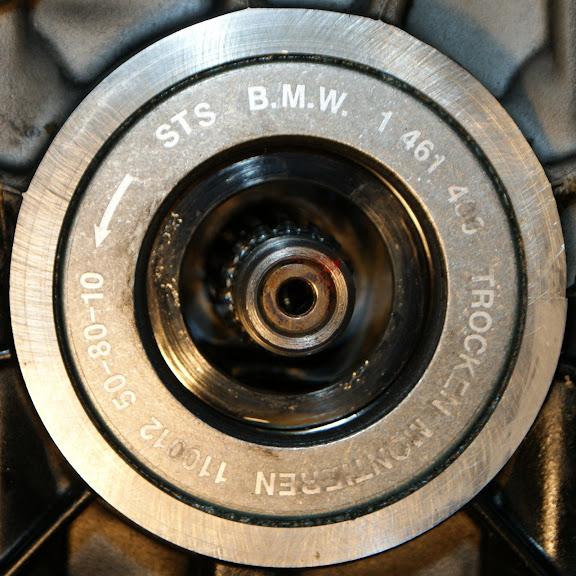
album link with zoom
I am totally confused about it.
The translation of "trocken montierer" is "dry assemblers" (Google trans.). The metal part and it's orgin and purpose is unknown to me. I have not meet such item in any manual: Haynes, Clymer, BMW Service Manual or Fling Brick guide to change clutch seal in K1100.
Please help me and tell should I reinstall it, and how?
Best regards
_________________
Rafal
K1100RS is a real beast (in Marrakesh Red)
K75S is a real beauty - she has gone  , but not to far , but not to far  . .
 |
|
| Back to top |
|
 |
RAL88
Flying Brick Rider

Joined: 28 Apr 2004
Posts: 736
Location: New Mexico Land of Enchantment and 365 days of riding USA
|
| Posted: Mon Apr 18, 2011 8:15 pm Post subject: |
|
|
That is the new updated shaft seal. I put one of them in when I did my bike.
_________________
Rich
"If it ain't broke, take it apart and make it work better"
*************
'96' K1100LT-SE
'97' R850GS-R |
|
| Back to top |
|
|
Rafal
Flying Brick Rider
Joined: 05 Jan 2009
Posts: 257
Location: Wroclaw, Poland
|
| Posted: Tue Apr 19, 2011 1:51 am Post subject: |
|
|
So it looks like this one was replaced before or is it factory setup? Can't find it's ETK number, therefore can't check the price or availability.
Any suggestions about leaving it as it is, putting "regular" seal or waiting for the new type one?
Best regards
_________________
Rafal
K1100RS is a real beast (in Marrakesh Red)
K75S is a real beauty - she has gone , but not to far .
|
|
| Back to top |
|
|
SugarHillCTD
Site Admin

Joined: 10 Oct 2007
Posts: 4238
Location: Now in Eastern Pennsylvania
|
| Posted: Tue Apr 19, 2011 6:03 am Post subject: |
|
|
Rafal,
As the very clever parts guy at MaxBMW (Rusty Gill) told me- as long as you have the bike apart that far- why not replace it. Better to do that than to re-use the seal and find it leaking in a few months and have to pull the bike apart again.
That is as long as you can easily get a new seal.
Good luck.
John
_________________
John & Cathy
'92 K100RS4V Pearl White SOLD
'04 K1200GT
IBA Several-SS1k, BBG, 50CC NYC to S.F. |
|
| Back to top |
|
|
Ernie-NH
Flying Brick Rider
Joined: 14 Oct 2009
Posts: 982
Location: Bristol, New Hampshire
|
| Posted: Tue Apr 19, 2011 9:30 pm Post subject: |
|
|

Hallo Rafal...
The words are " trocken montieren" it is,a verb (not a noun) and is telling you to assemble the part dry !! ( ie: no grease !! )
OK...? The seal itself is a 50mm ID (Innendurchmesser) x 80 mm OD x 10 mm in height. You can use any metal OD generic seal with these dimensions, BUT the material ( rubber ) MUST be a fluroelastomer like Viton or Durel. ie FKM The difference between the BMW version of the seal as opposed to any generic will be the 'radial load' that the sealing lip bears on the shaft. IF they are a FKM however, the differences will be slight. See if you can find a Simrit ( ie: Simmerring ) Katalog and you can select one or ask you auto parts dealer.
Best of luck......// Ernie in NH
_________________
AMA,, American Deaf Bikers
Airhead Beemers Club
'11 G650gs
'95 K1100LT
'76 R100/7 |
|
| Back to top |
|
|
Rafal
Flying Brick Rider
Joined: 05 Jan 2009
Posts: 257
Location: Wroclaw, Poland
|
| Posted: Wed Apr 20, 2011 1:43 am Post subject: |
|
|
Hello!
Thank you for all the answers. The new seal is ordered form BWM and waits on the shelf .
Dry installation is something new for me, because on Max BMW catalogue there is an information to soak the seal for 2 hrs in engine oil before installation.
In Polish there is a technical noun for Simmering, but every one says Simmering  . .
_________________
Rafal
K1100RS is a real beast (in Marrakesh Red)
K75S is a real beauty - she has gone , but not to far .
|
|
| Back to top |
|
|
Ernie-NH
Flying Brick Rider
Joined: 14 Oct 2009
Posts: 982
Location: Bristol, New Hampshire
|
| Posted: Wed Apr 20, 2011 10:08 pm Post subject: |
|
|
Hi Rafal...
The term Simmering is the common word for a Radial Shaft Seal, like Softie or Kleenex is for tissue. The Simmerring was named after its developer H. Simmer an Austrian engineer from Kuefstein, who developed the profile ( DIN 3761 ) in 'rubber' ( ie: Nitrile ) in 1937 after BUNA was invented to replace leather. The term Simmering is now accepted all over Europe.
The idea that such a seal should best be assembled dry, comes from the fact that in the first few seconds on operation after the seal has been installed, it will develop a 'track' or 'scar' on the surface of the shaft which will be between 5 and 10 microns in depth, almost a polish one could say. The interaction of the seal and the shaft being sealed causes the oil to build a miniscus at the point on the shaft where the 'track' has formed across which oil is continually pumped on a microscopic level back into the so-called pressure side of the seal. ( ie: the engine side ). Because of the asymmetry of the sealing lip profile, the pressure exerted on the oil on the "air side" is higher than that on the "oil side" thus causing a replenishing of fresh oil and a taking away of the heat which would otherwise destroy the elastomer making up the lip. Be SURE that you NEVER wipe the the sealing lip with anything for any reason !!! It is the surest way to shorten the lifespan of the seal or even compromise its function.
Good luck, I hope some of this has been a help.
Best regards..........// Ernie in NH
_________________
AMA,, American Deaf Bikers
Airhead Beemers Club
'11 G650gs
'95 K1100LT
'76 R100/7 |
|
| Back to top |
|
|
Rafal
Flying Brick Rider
Joined: 05 Jan 2009
Posts: 257
Location: Wroclaw, Poland
|
| Posted: Thu Apr 21, 2011 2:36 am Post subject: |
|
|
+1 Excellent knowledge about important, yet under estimated part of every engine or mechanism in general!
Thanks a million, I am keeping learning all the time.
_________________
Rafal
K1100RS is a real beast (in Marrakesh Red)
K75S is a real beauty - she has gone , but not to far .
|
|
| Back to top |
|
|
SugarHillCTD
Site Admin
Joined: 10 Oct 2007
Posts: 4238
Location: Now in Eastern Pennsylvania
|
| Posted: Thu Apr 21, 2011 5:43 am Post subject: |
|
|
Ernie,
You are THE MAN. Thanks for the explanation.
Rusty at Max BMW told me about the dry installation and sort-of explained but you really put the "why" behind it.
Thanks.
John
_________________
John & Cathy
'92 K100RS4V Pearl White SOLD
'04 K1200GT
IBA Several-SS1k, BBG, 50CC NYC to S.F. |
|
| Back to top |
|
|
Ernie-NH
Flying Brick Rider
Joined: 14 Oct 2009
Posts: 982
Location: Bristol, New Hampshire
|
| Posted: Thu Apr 21, 2011 11:26 am Post subject: |
|
|
Hi John... Hi Rafal...
Just a boring follow up note to the "track" that forms on the shaft. The depth and actual surface finish of the "track" is dependent (a). on the material that the shaft is made from as well as the hardness,, (b) on the physical geometry of the 'rubber' lip bearing on that shaft. In one case the lip of the seal may be 'ready molded' meaning that its geometry is that which comes directly from the mold slightly rounded, and in a second case, the lip may be cut after molding using a knife to create a sharp edge. The 'molded lips' have an epidermis as a result of molding gasses forming at the lip and are less permeable to the media being sealed, BUT the pressure they exert on the miniscus tends to be less thus lowering the 'pump back' nature of the design. The 'cut or trimmed' lips have a much more pronounced bearing on the miniscus ( ie: the shaft ) and are somewhat more efficient in keeping the lip temperature from rising due to friction. Trimmed lips are of curse more costly to produce since they involve an additional manufacturing step. The drawback to the 'cut lip' feature is that the epidermis is removed thus allowing for a higher level of permeability of the 'rubber' at the lip by the media being sealed, thus causing a slight reduction in hardness. Both designs are functional.
All in all however, a seal ( not a packing ) is a matter of simply controlling leakage. When designing a Radial Shaft Seal, we always said to ourselves in every sealing application : " Wieviel Leckage ließt die Kunde zu ??" ( ie: How much leakage will the customer allow ?? ).. zero never being the case in life studies. Simply put, influencing of the hydrodynamic effect of the lip on the shaft by astute design is the manner in which that leakage is controlled.
Maybe now you know a bit more than before about the complexity of these simple seals we replace as often as we do....eh?
Have fun all, and hope your family Rafal is doing well this Easter !
Best regards.........// Ernie in NH
_________________
AMA,, American Deaf Bikers
Airhead Beemers Club
'11 G650gs
'95 K1100LT
'76 R100/7 |
|
| Back to top |
|
|
|

 FAQ
FAQ Search
 Memberlist
 Usergroups
 Register
 Profile
 Log in to check your private messages
 Log in


